Relief & Rebuild Field Team
Clean Water and Solar Well
Imagine a rural African community where the sun provides the energy to pump clean water—giving families healthier lives, farmers the ability to grow more food, and children more time for school. Relief & Rebuild envisions a future where solar-powered wells become the foundation for education, sustainable agriculture, local jobs, and long-term prosperity across rural Africa.
From Clean Water to Prosperity: Solar-Powered Wells for Rural Africa
For millions of people living in rural communities across Africa, access to reliable clean water is more than a health issue—it is an economic development issue.
A community without dependable water faces challenges in almost every part of daily life. Families spend valuable time collecting water. Children may miss school. Farmers struggle to produce crops during dry periods. Livestock becomes harder to maintain. Small businesses have difficulty developing. And when water systems depend on expensive fuel or unreliable electricity, even a completed well can become difficult to operate.
A solar-powered water system offers a different possibility.
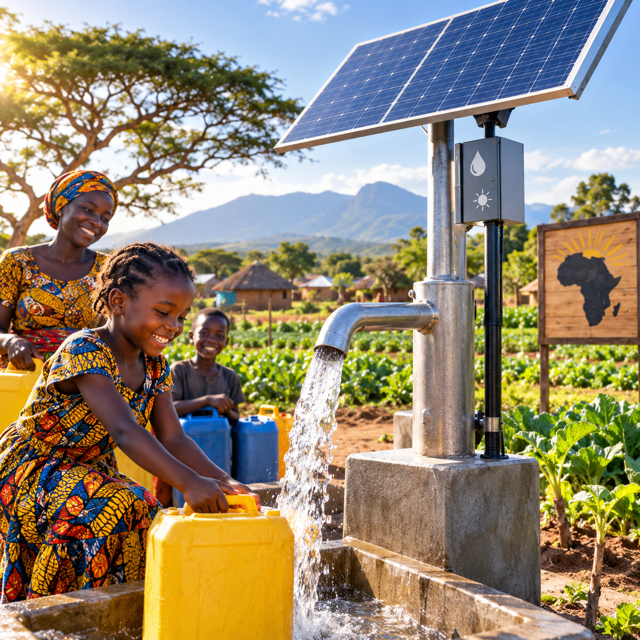
Instead of relying on diesel generators or an unreliable electrical grid, solar panels can provide electricity to pump groundwater into a storage tank, community distribution system, agricultural irrigation system, or livestock watering area. With proper water testing, treatment, maintenance, and community management, the result can be a sustainable infrastructure system that serves a community for years.
Water Can Become the Beginning of Development
The goal should not simply be to build a well.
The goal should be to build an economic ecosystem around reliable water.
Clean water can support:
Health: reducing exposure to contaminated water and improving hygiene.
Education: reducing the amount of time children spend collecting water.
Agriculture: allowing farmers to grow food more reliably and potentially cultivate additional crops.
Livestock: providing dependable water for animals.
Small businesses: supporting food processing, market gardens, restaurants, shops, and other enterprises.
Women's economic opportunity: reducing the burden of water collection and creating more time for education, work, and entrepreneurship.
Local employment: training community members to maintain pumps, solar equipment, irrigation systems, and water infrastructure.
Food security: using reliable water to increase local food production.
Community resilience: reducing dependence on fuel and centralized electrical infrastructure.
This creates a powerful development cycle:
SUN → SOLAR ENERGY → CLEAN WATER → AGRICULTURE → FOOD → JOBS → INCOME → EDUCATION → PROSPERITY
Countries Where This Model Could Have Significant Potential
The model could be adapted to many parts of Africa, particularly rural and underserved communities in countries such as:
🇪🇹 Ethiopia
Rural Ethiopia has enormous agricultural potential, but many communities face water-access challenges and variable rainfall. Solar-powered pumping combined with water storage, irrigation, agricultural training, and local cooperatives could help communities produce more food and develop agricultural businesses.
🇰🇪 Kenya
Kenya has significant experience with solar energy and decentralized infrastructure. Rural communities could combine solar-powered wells with livestock watering, irrigation, schools, health facilities, and small agricultural enterprises.
🇹🇿 Tanzania
Tanzania's large rural population and agricultural economy make reliable water infrastructure particularly important. Solar-powered community wells could support drinking water, livestock, irrigation, and small-scale food production.
🇺🇬 Uganda
Uganda has substantial agricultural potential and a large rural population. Water projects could be connected to farming cooperatives, schools, health centers, and small businesses, helping communities move beyond simply receiving aid toward generating sustainable economic activity.
🇲🇼 Malawi
Malawi is highly dependent on agriculture, making reliable water particularly important for food security and rural incomes. Solar-powered irrigation and community water systems could help farmers become more productive while reducing dependence on rainfall alone.
🇿🇲 Zambia
Zambia has extensive agricultural land and relatively low population density in many rural areas. Solar-powered water systems could support farming communities, livestock, schools, and emerging rural businesses.
🇲🇿 Mozambique
Mozambique has significant rural development needs alongside major agricultural potential. Solar-powered water infrastructure could be particularly valuable in communities where extending traditional electrical infrastructure is difficult or expensive.
🇸🇳 Senegal
Senegal has significant experience with solar energy and agricultural development. Solar pumping could support irrigation, livestock, drinking water, and agricultural cooperatives, particularly in areas affected by water scarcity.
🇬🇭 Ghana
Ghana has a growing economy but still has rural communities where infrastructure and reliable water access remain challenges. Solar-powered water systems could be connected to agricultural production, schools, health centers, and rural entrepreneurship.
🇳🇬 Nigeria
Nigeria's enormous population means that even relatively small improvements in rural infrastructure can have a major impact. Solar-powered water systems could serve rural communities while supporting agriculture, livestock, schools, health facilities, and local businesses.
🇷🇼 Rwanda
Rwanda offers an interesting model for integrating infrastructure, agriculture, technology, and community development. Solar-powered water systems could complement broader efforts to improve rural productivity and access to essential services.
The Important Difference: Relief and Rebuild
The philosophy behind Relief & Rebuild should be that relief is only the beginning.
Providing water addresses an immediate need.
But providing water and the infrastructure to produce food, create businesses, educate children, train workers, and maintain the system locally begins to address the underlying causes of poverty.
A project could therefore start with a community assessment:
1. Water
Identify an appropriate water source, conduct water-quality testing, and determine sustainable extraction levels.
2. Solar Energy
Install appropriately sized solar panels, pumps, controls, and battery/storage solutions where needed.
3. Storage
Build elevated or ground-level water storage so water remains available even when the sun is not shining.
4. Agriculture
Use a portion of the water system, where hydrologically appropriate, for community gardens, irrigation, livestock, or other productive activities.
5. Education
Connect the project to schools and provide education around water conservation, sanitation, agriculture, solar technology, and entrepreneurship.
6. Employment
Train local residents to operate and maintain the system rather than creating permanent dependence on outside organizations.
7. Enterprise
Encourage businesses that can develop around the new infrastructure—agriculture, food processing, transportation, repair services, markets, and other local enterprises.
8. Reinvestment
Where appropriate, a portion of agricultural or enterprise revenue can help fund maintenance and future community improvements.
Building a Sustainable Community
The ultimate objective isn't simply to install thousands of wells.
It is to create self-sustaining communities.
Imagine a rural community where a solar array powers a water pump. The pump fills a storage tank. The water provides drinking water for families and irrigation for a community farm. Farmers produce vegetables and other crops. A local cooperative sells the harvest. Children spend more time in school. Local workers maintain the solar and water equipment. Businesses develop around the agricultural activity.
One infrastructure investment begins supporting multiple parts of the local economy.
That is the difference between charity that solves today's problem and development that helps create tomorrow's opportunity.
A Vision for Africa
Africa does not need to be defined by poverty.
The continent has enormous human potential, agricultural resources, sunlight, entrepreneurial talent, and rapidly developing technology. The challenge is connecting these resources to communities that have historically lacked infrastructure and opportunity.
Solar energy and clean water cannot solve every problem.
But together, they can become an important foundation.
Relief & Rebuild can help create a model in which clean water leads to agriculture, agriculture leads to income, income leads to education and enterprise, and enterprise creates greater independence.
The vision is simple:
Educate. Sustain. Provide. Rebuild. Empower.
And ultimately, the objective is to help communities move from survival to opportunity—and from opportunity to prosperity.